
Why Healthy Food Suddenly Causes Bloating After 40 (And What Your Gut Is Trying to Tell You)
You’re eating healthier… so why do you feel worse?
You clean up your diet.
You eat more vegetables.
You start paying attention to what’s on your plate.
And instead of feeling better…
- you feel more bloated
- more uncomfortable
- more reactive to foods that used to feel fine
If that’s happening, it’s easy to assume:
“Something must be wrong with the food.”
But that’s not actually what’s going on.
➛ It’s not the food.
It’s how your body is responding to it.
Listen, Watch and Subscribe:
 YouTube episode here.
Why This Feels So Confusing
This is one of the most frustrating patterns I see in midlife women.
Because it feels like you’re doing everything right.
You’re eating whole foods.
You’re making better choices.
You’re trying to support your body.
And yet…your digestion gets worse
So you start removing things.
Gluten.
Dairy.
Certain vegetables.
Until your diet becomes more and more restricted but you still don’t feel better.
That’s not a food problem.
➛ That’s a system problem.
What’s Actually Happening In Your Gut
Digestion is not passive.
It’s an active, energy-dependent process.
Your body needs to:
- produce stomach acid
- release digestive enzymes
- move food through at the right pace
- maintain a gut lining that can tolerate what you’re eating
And all of that depends on:
➛ energy
➛ coordination
➛ and a regulated nervous system
When your body is under strain, digestion is one of the first things to take a hit.
Why This Shows Up In Midlife
This is where things shift. As estrogen declines, your body becomes less resilient.
Estrogen doesn’t just affect your cycle.
It also:
- helps maintain the gut lining
- plays a role in regulating inflammation
- supports how your body responds to stress
So as those levels change, your system becomes more sensitive.
That can look like:
- more reactivity to foods
- more inflammation in the gut
- increased permeability (“leaky gut”)
- lower tolerance for stress overall
And this creates a loop:
➛ stress impacts the gut
➛ the gut becomes more reactive
➛ which creates more stress on the body
This is what I call the hormone–gut–nervous system loop.
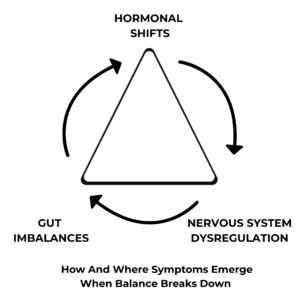
When one side gets thrown off, the others follow.
Why Healthy Food Starts Causing Bloating
Now let’s connect this to what you’re actually feeling.
You eat something like:
- a salad
- vegetables
- fiber-rich foods
But your body can’t break it down efficiently. So instead of being properly digested…
➛ the food sits
➛ it ferments
➛ gas builds
That’s the bloating.
So again, it’s not random. And it’s not because the food is bad.
➛ It’s because your body isn’t able to handle it properly right now.
And that’s why doing more, often makes things worse.
The Pattern Most Women Miss
Here’s how this usually plays out.
You decide to “clean things up.”
You eat better.
More whole foods.
More vegetables.
And within a few weeks…
➛ you feel worse.
So you start removing foods.
First gluten.
Then dairy.
Then more and more foods.
Until your diet becomes incredibly limited…and nothing really improves.
That’s not a food sensitivity issue.
➛ That’s your system struggling to respond.
Where Peptides Fit Into This
This is where things start to shift.
Because when the gut lining is irritated or inflamed, even healthy food can feel like a problem.
At that point, avoiding foods isn’t enough.
➛ you have to support the environment those foods are interacting with
This is where more targeted tools can come in.
For example:
- BPC-157 can support repair of the gut lining
- KPV can help calm inflammation in the gut
- TB-500 can support overall tissue repair and reduce inflammation system-wide
But here’s where most people get it wrong.
➛ they start here – too early.
And when that happens:
- they don’t notice much of a difference
- or they feel worse and assume it’s not working
In reality…
➛ their body just isn’t able to use that support yet.
Because if your system is overwhelmed…
➛ it’s focused on survival, not repair.
What Actually Helps (In The Right Order)
This is the part that matters most. Because it’s not about doing more.
➛ it’s about doing things in the right order
-
Don’t immediately remove all “healthy foods”
Unless you’ve done proper (practitioner-level MRT Food Sensitivity) testing, removing foods usually doesn’t solve the problem.
➛ it just creates more restriction
The goal is not elimination.
➛ it’s rebuilding function
-
Make foods easier to digest
Instead of asking your body to do more, make the job easier:
- choose cooked foods over raw
- chew thoroughly (more than you think you need to)
- eat without distractions
Small shifts like this can make a big difference.
-
Support your nervous system
Digestion only works well when your body is in a state where it can actually process food.
If you’re always in “go mode” digestion takes a back seat.
If you’re not sure how to do this, grab my Stress-Busting Breath free guide.
-
Rebuild your mineral status
This is foundational. If sodium and potassium are low, digestion will continue to struggle.
One simple place to start is something like an adrenal cocktail:
- ¼ tsp Celtic salt
- ¼ tsp cream of tartar
- juice of half a lemon
- 4 cups of water
Try it once or twice per day and notice how your body responds.
-
Then layer in targeted support
This is where most people start. But it’s actually the last step.
Once your body is more supported, then things like:
- digestive enzymes
- gut support protocols (from GI Map testing)
- and in some cases, peptides
can actually make a difference.
Because now, your body can use them.
The Bottom Line
If healthy food suddenly makes you feel worse…
➛ it’s not the food
➛ it’s that your body isn’t functioning optimally right now.
And until that changes…
➛ adding more or restricting more won’t fix it.
This is also why I’ve started incorporating peptide support into my work with clients.
Because once the foundation is in place, some women need a more targeted approach to help their body actually shift.
And when used at the right time, this can make a significant difference in symptoms that have felt stuck for a long time.
Next Steps
If you’re thinking: “Okay… but why isn’t my body responding?”
Start here:
➛ Take the Midlife Body Code Quiz
This will show you:
- how your body is currently responding
- what stage of dysregulation you’re in
- and what needs to come first
So you can stop guessing…and finally start making progress.